
What is a digital substation?
A digital substation uses standardized digital communication to connect protection, control, measurement and monitoring systems. Electrical measurements, equipment status and commands are exchanged over communication networks, with IEC 61850 providing a common foundation.
In a fully digital process architecture, merging units and process interfaces replace much of the conventional secondary signal wiring with digital communication. The primary equipment still carries and switches electrical power — the digital infrastructure provides the information needed to protect and control it.
IEC 61850: more than a protocol
IEC 61850 is an international standards series for power utility automation. It defines common information models, communication services and a standardized configuration language for engineering.
Three communication services play important roles:
- MMS: measurements, reports and control between devices and supervisory systems.
- GOOSE: fast exchange of events, such as protection trips and interlocking signals.
- Sampled Values (SV): digital streams of current and voltage measurements.
Standardized data models and configuration files support integration between devices and engineering tools. Successful interoperability still requires coordinated engineering and testing.
Station bus and process bus
The station bus connects protection and control devices with the operator interface, station controller and gateway. It supports supervision, control and communication between devices.
The process bus connects these functions with interfaces near the primary equipment. Merging units publish digital current and voltage measurements, while process interfaces exchange switching commands and equipment status.
For selected applications, routable GOOSE (R-GOOSE) and routable Sampled Values (R-SV) extend communication over IP networks, including between substations.
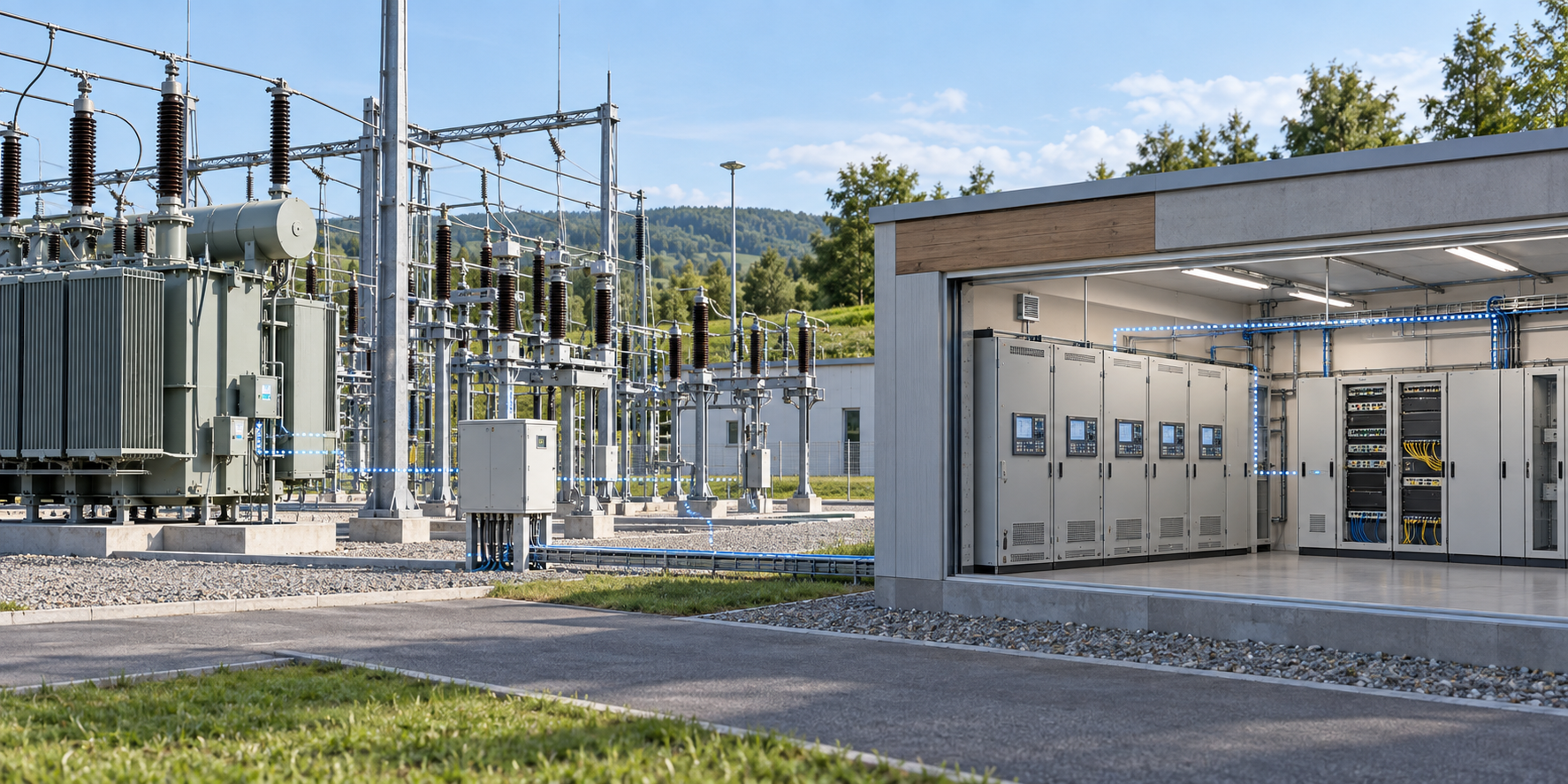
AI-generated conceptual illustration.
Precise timing and reliable networks
Protection functions may need measurements from different sources to be precisely aligned. Precision Time Protocol (PTP) provides accurate synchronization, using the power utility profile defined in IEC/IEEE 61850-9-3.
Network design must also account for bandwidth, traffic priorities and multicast communication. Redundancy technologies such as PRP and HSR maintain communication during covered single network failures without a recovery interval.
Time synchronization and redundancy must be monitored and tested as parts of the complete protection and control system.
Cybersecurity and user roles
A digital substation requires controlled access to its devices, networks and engineering systems. Network segmentation, device hardening, secure remote access and security logging help protect its operation.
VLANs organize and separate network traffic, but need to be combined with appropriate security boundaries and access controls.
Role-based access control assigns different permissions to operators, engineers, maintenance personnel and administrators. The IEC 62351 series provides security specifications for power-system communication and associated functions.
Benefits and further development
Digital communication can reduce secondary signal wiring, make measurements available to multiple functions and improve diagnostics. These benefits depend on careful engineering, consistent configuration management and testing of the complete functional chain.
Digital architectures also support virtualized protection and automation, where selected functions run as software on suitable computing platforms. This is an additional design option; a digital substation does not require virtualization.
The objective remains reliable protection and control throughout the substation’s lifetime.